Protein multiverse: empiricism vs rationalism
Share on:There’s an interesting inefficiency in the market: most of the revenue of lab vendors is produced by consumables, labware and reagents for their equipment. Hence, they are incentivised to proliferate compatibility conflicts — each vendor has its own special type of labware, e.g. a 96-well plate. I cannot swap one 96-well plate for another, because that would ruin the current lab equipment’s business model. Hence, I have to buy four types of pipette tips, three types of plates, three types of reagents, etc. Or I have to lock into one vendor’s ecosystem, and sacrifice the advantages and potential benefits of using other ecosystems’ devices that are more optimized for my task at hand. So I decide to sacrifice my free lab space instead, and stash more boxes that I use casually for all the useful devices I have at hand. There’s a place for a company that would develop a shared lab standard and find a way to resolve the incentivised compatibility issues — in the end, all the vendors would benefit from having a shared standard, because they would obtain more users as a result and increase their shared market size. None of them would do it willingly (because that’s shooting themselves in the foot), but if an outsider does it for them, it may turn into a profitable business, which would raise all the boats and significantly speed up progress in biology (and its automation).
At MBC Biolabs, where we rent our lab space, we need to get trained by a vendor’s representative to get access to booking and using their equipment. I finally got access to some interesting devices. Biology is surprisingly well optimized for throughput and price. One device automates DNA extraction without hands-on time at all — it allows processing one sample at a time, and getting straight to the purified and extracted DNA in 75 minutes (in other words, you’d be able to process 6 samples during a regular workday). There are two caveats — it took me almost 6 weeks to get the cartridges for the device (they are often back-ordered because of their rarity and a small market size), and the second one is that it can only process one sample at a time.
Imagine running a small-scale screen, when you need 16 DNA variants. If you use the device, it would take you 20 hours, or roughly three days of re-loading the device. You wouldn’t need to do any hands-on work, but the wait time quickly explodes, and renders any reasonable-scale screen not practically viable — although perfectly automated. On the other hand, you can buy a simple manual kit for DNA extraction, and run those samples in parallel — yes, it would take about 1-2 hours of your hands-on time to do so. But it’s one and done: if you start early in the morning, you’ll have 16 plasmids ready for the next experiments by lunch, and the throughput bottleneck gets resolved. The physical space requirements are also critical. The cartridges turned out to be gigantic (the size of a decent baking tray that would fit an average Thanksgiving turkey). I ordered 16 of those, and they arrived in 4 gigantic boxes (4 cartridges per box), which easily occupy a quarter of my free lab space. The standard kit is only a single tiny box which I can simply shelve. TL;DR — such automation devices are good to have, but, unfortunately, they are not a universal solution, and have their own pros and cons. I’ll most likely use it for casual DNA preps here and there, when I don’t need much throughput.
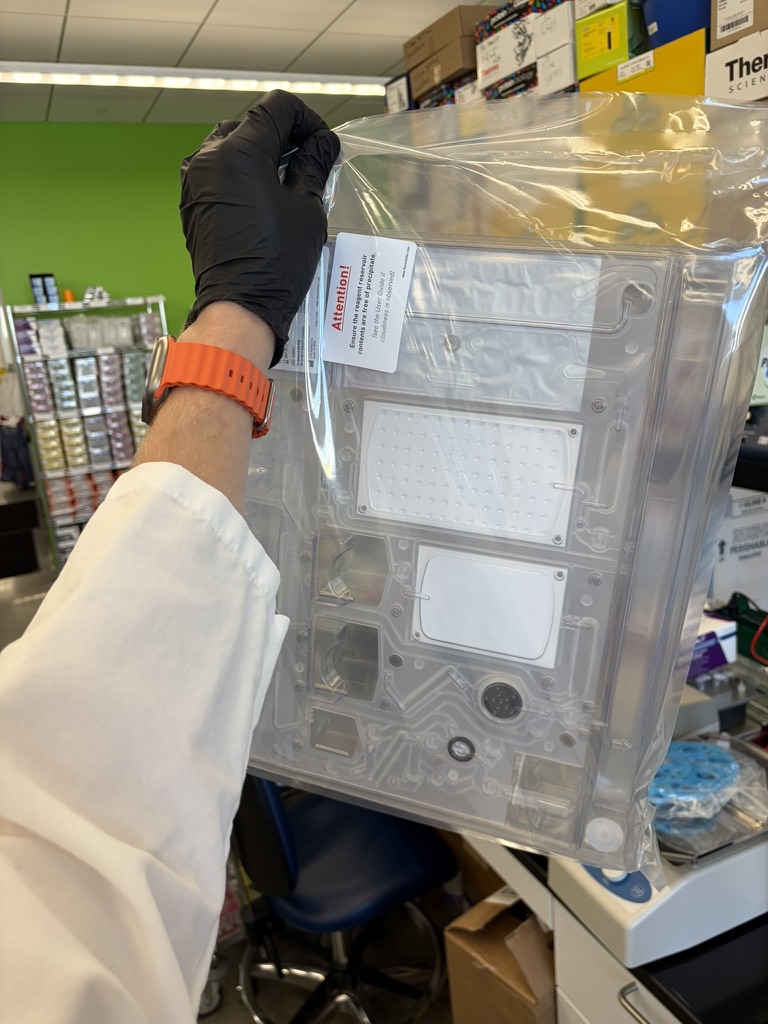
The second device helps automate some steps of protein production quality control (QC) — it measures the mass distribution of the sample. The alternative is SDS-PAGE, an electrophoresis gel, which shows how fast your proteins run in a gel: the bigger the protein, the slower it moves under a constant applied electric force. Neither is really automatable. The gel allows running 26 samples at once (but it takes roughly 2 hours, with about 20 minutes of hands-on time), while the device only runs 1 sample at a time (but it takes only 1 minute per sample, and you get an immediate answer about your protein’s purity). Of course, the consumables for the device are more expensive than the gel and its reagents (“the efficient-market hypothesis” works here). Getting a quick answer is definitely worth it for early debugging.
This device turned out to be extremely helpful even during the training session — I could run a few of my samples, and immediately noticed that one of my puzzles from before got resolved. I produced a protein, and it looked very clean according to the gel — but it turned out to be almost 10x less pure according to the photomassometry (which is more reliable and is not biased by protein sequence peculiarities). I quickly understood why I had struggled with some protein processing steps and the assays using this protein: I had simply interpreted its purity incorrectly, because my “sixth sense” relied on the gel that was misleading me. This is how purely philosophical discussions between empiricists and rationalists of science materialize in real practical scenarios. TL;DR — they argued whether the scientific method probes real mind-independent objects, or whether those objects get distorted by our senses and their extension through various scientific instruments, so that we simply sense the corrupted measurement data emanating from the “real” objects.
The only way I could “see” this protein was by incorporating GFP (green fluorescent protein). It glows green when you shine blue light on it, so I could use my eyes. The rest is through scientific instruments — e.g. the electrophoresis gel (SDS-PAGE), or the photomassometry, or some downstream tests like whether they trigger a relevant reporter and to what degree. In other words, my knowledge of what’s going on is fundamentally limited by the available ways to measure and “sense” the protein. Having an additional sense (i.e. device) unlocked a more precise approximation of what was actually going on. I thought that I had dosed my protein at some level, and it turned out to be at least 10x less than that. And I went for the second round of my protocol optimization.
It’s surprising how little we can actually measure, how noisy our measurement devices are, and, as a result, how patched and sparse our “senses” are for developing these new proteins. Proteins execute dozens (if not hundreds) of functions in various scenarios. We barely have tools to scrape the surface of all that complexity. It’s common in science in general, and hence scientists build world-models (or simply scientific theories, in the pre-AI-hype era) — they use the scientific method. The method acknowledges that our practical capabilities are fundamentally limited, but also enforces that whatever theory we build must satisfy a few requirements: at the very least, it must be predictive of our experimental outcomes. We may not be able to fully validate every part of a theory, but its predictions should work in the tiny subspace of all measurements that we are actually able to conduct. That’s the case in physics for the Large Hadron Collider, and the measurable scattering diagrams for various particles’ collisions, which we use to test the Standard Model. It’s the case here with the proteins — we don’t know everything about them, but we have enough readouts and control over their sequence (we design them!) to be able to optimize their function. We use a somewhat “black-box”-y approach, but it’s a fundamental limitation — we’ll never be able to measure everything about everything.
We improve our AI engine from real-world feedback. For example, even our first pilot, with only 2 designed and produced proteins, taught us a ton regarding their nature. One had a hard time expressing at all, the other expressed fine — the only difference is 5-10% of their sequence, which is easily interpretable for the next steps of their optimization. AI knows everything about everything (or nothing, depending on your philosophical position) — without feedback from reality, all options stay possible and almost equivalent to it, and we live in a multiverse. As soon as I give it a pair of proteins with a clear phenotypic difference measured experimentally, it immediately collapses enormous swathes of the protein search space, and guides it to improve in the next iterations (thus collapsing half of the multiverse for the AI!). That’s how our approach works. It’s foolproof and not able to fail, as long as we stay conscious about using only high-signal readouts. It also converges super fast — from my prior experience, it’s enough to run it 2-3 times until it converges to a decent solution.
Share on:Let's stay in touch
Subscribe to receive updates about my work in longevity research and advances of life-extending and anti-aging therapies.