A day in the lab
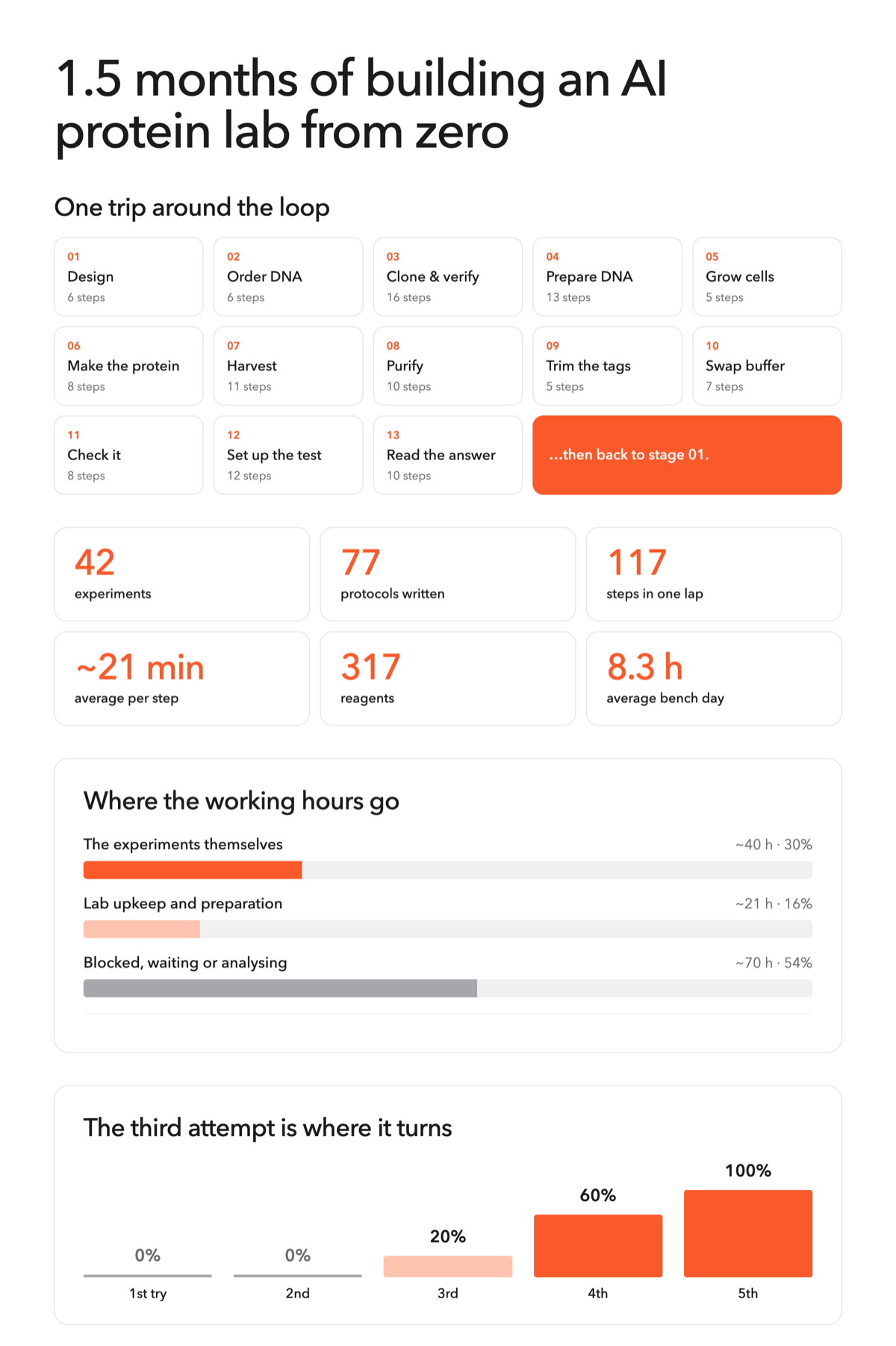
Share on:My angels are bugging me to post more — I tend to work so much these days that I barely have time to write things down in a reader-friendly way. Here you go! A typical day in the lab (in a Gen Z friendly format!):
A lot has been done to close the loop — of course, biology is, as usual, complex. And, of course, the magic rule of three holds true! On the progress side — we set up and optimized cloning in house, optimized DNA plasmid prepping at scale, protein production protocols and the subsequent purification, quantification and quality control, and optimized the readout. Yesterday, I finally got to the point where I had our proteins purified and quantified, ready to dose into the cells! Of course, it’s only the first attempt, and it will take two more to make it work seamlessly. So far the major unlock is that we finally got to N=1: we have experienced all the unknown unknowns and completed the first full pilot. From now on, they are known unknowns, and we’ll have to debug and optimize the whole protocol a few more times to convert them into known knowns.
A good old friend visited me this week and said that seeing an absolutely happy person working at 2x speed was very inspiring to him! We have known each other for almost two decades, so I’ll take it as a positive piece of feedback! I was rushing three experiments in parallel, while arguing with my AI engine in between.
Speaking of AI, I didn’t really like talking to chatbots on my commute to and from work — mostly because they were dumb and couldn’t remember all the context relevant to me. Now that everything is fully integrated with my AI infrastructure, I realized I can simply talk to my AI engine (called Robin, by the way!), using the memoryless chatbot as a convenient UI while my hands are on the wheel. Holding a Socratic dialogue with the full history of our experiments, protein designs, protocols, reagents, all the papers and data provides a synergetic benefit. I also integrated my lab task management into it. Since I usually struggle with calendars and timekeeping, I turned to the “Getting Things Done” strategy — instead of hard-core time-bound tasks, it gives more flexibility. For each project, it outlines tiny titbits of tasks which can be done asynchronously, whenever you actually have a window to execute them (unless they are critically time-sensitive, which is actually quite rare in the wet lab), and provides the next-step task. It eliminates the need to think about what to do next, because you always have a stack of tasks pre-prioritized for today by your past self, who was more in the flow. Long story short, I can now sync with AI on what needs to be done today on my commute to work, and re-set priorities for the next day on my way back home, while I still remember everything that has been done. My scheduling anxiety plummeted after I started using it.
The practical beauty of AI, with all its current imperfections, is that one can stop worrying about structuring things and wasting time on it. Why spend your time on dozens of slide decks, if AI can automatically convert your raw data and lab notes into a summary deck? Why spend time pushing people to follow one standard for structuring data, if AI can convert any tangible data representation into another without friction? Keeping track of everything in one place gives non-linear boosts in productivity and capabilities. So-called recursive self-improvement is not an abstract concept — it becomes very practically tangible as soon as you realize that AI can optimize your next protocol run from your previous one and your notes overnight, while you’re sleeping.
The future has a very bright outlook to me these days!
Share on:Let's stay in touch
Subscribe to receive updates about my work in longevity research and advances of life-extending and anti-aging therapies.