The magic rule of three
The entry barrier to a mediocre and not super respected job of moving liquids around in the wet lab is insane. People spend years and decades training for it, and, in the end, the market imposes a huge discount on their sacrifices. A wet lab person would be priced 1.5-2x lower, or even more, than someone who has never touched a pipette. Add to that the discount for doing a postdoc in academia, which drags one’s salary down for up to 15 years afterwards — you get the point. It sucks to be a wet lab biologist, and nobody (=the market) really respects you for doing that. Then don’t be surprised that each approved drug costs $2B to make.
I haven’t passed through the selection filter to work in the wet lab. Traditionally, years of lab work as an undergrad, PhD, postdoc, etc. would select a person who is very patient and organized, and has highly developed motor skills and mechanical memory. If you ask such a person to open a tube with two fingers of their left hand while pipetting something with their right one, their ambidextrous super-abilities would allow them to do so. My hands are shaky, I always forget where everything is in the physical world, and I’m not a good friend of time and strict scheduling. In other words, I don’t think I would’ve survived and passed the traditional wet lab filter. I do have other super-abilities which I developed in my careers as a theoretical physicist, an AI x bio researcher, an aging researcher and a wet lab biorobot (in the last two post-AI years of my life) — and they do help me cope and compensate for the lack of traditional wet lab adaptations.
Being a night owl gives me an unusual competitive advantage in the traditional early-bird wet lab environment — in my ecological niche, nobody is competing for TC hoods and other lab equipment after 4 pm. I do enjoy cooking, and the wet lab for me is like a kitchen. I can come up with new recipes, and feel confident about experimenting and testing out various protocols. I also have no problem with failing and looking stupid — that’s definitely the fastest way to learn. Fail once, learn, fail twice — at some point the result will be good enough, and then I can easily improve iteratively from there on.
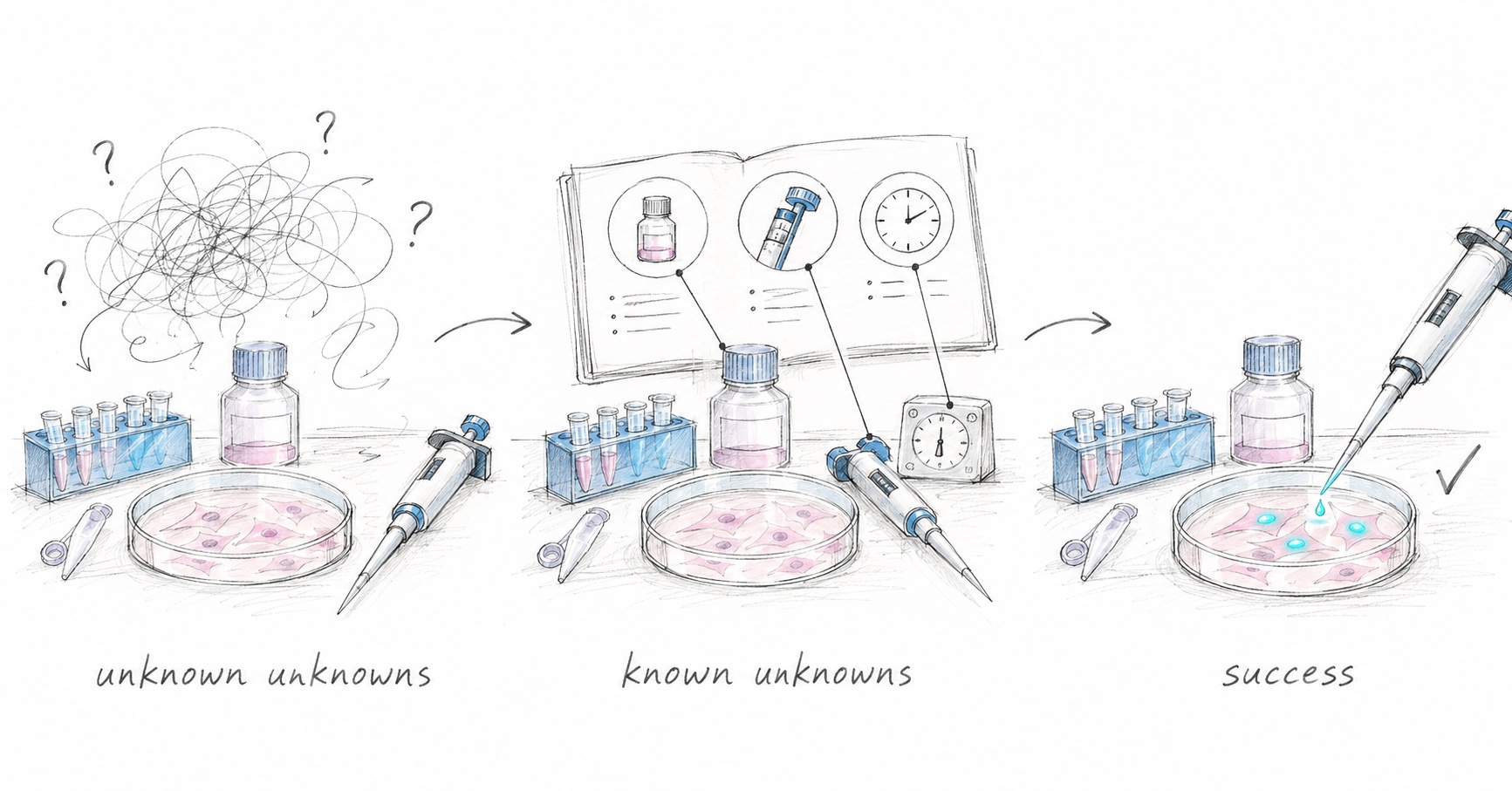
From my prior observations, being afraid to start or to look foolish has been the major reason for failure — it’s not even that an experiment was crappily executed and failed, it’s that it hasn’t even been attempted. This week was all about the rule of three: three iterations are needed to go from 0 to 1. In the last week, we passaged and banked a ton of cells, debugged plasmid transfections and calculations, produced the first proteins and plasmid preps, tested out a new reporter readout, etc. To be honest, nothing worked on the first attempt, for the “unknown unknowns” reasons which suddenly pop up when one starts setting up a new lab from scratch — backordered reagents, missing labware, incompatible equipment, etc. But it did start working on the second or third run because, first, the unknown unknowns converted into known unknowns, then I could quickly find a solution — and then it would suddenly start working. So far the magic rule of three has been unbreakable.
Science is about hypothesizing, trying, testing reality, and updating your priors afterwards. Try, fail, improve, repeat — that’s the essence of science to me. It doesn’t really matter if it’s physics, AI, biology or any other field. The scientific method is universal, and it’s been the major transferable skill I learnt in my field-hopping career.
My Harvard friend has been helping out with various steps and taught me a few things. Still, we did mess up our first bacterial transformation and selection. His 10 years of experience, a Harvard PhD, and simply having done it hundreds of times before, unfortunately, didn’t directly translate into a reduced magic number. We still failed together, for a reason that is obvious in hindsight but had not been obvious before we made the mistake. It’s hard to blame people for making mistakes in the lab — in my experience, nothing in the wet lab was designed to be human-friendly. Everything requires keeping track of hundreds of things at once, and a single mishap can and will ruin the whole experiment.
While trying to fix it, I’ve been extensively integrating our AI engine with the physical reality of the wet lab. It’s been a roller coaster — at times it would magically zero-shot a problem, at others it would make stupid mistakes. I integrated it with my calendar as well — now it tells me not only what to do but also when.
I can easily see how a company that has successfully integrated AI with the physical world of the lab, with all its imperfections, would quickly be eons ahead of its competitors. The problem is not that AI cannot do it — quite the opposite — it’s that people are not willing to accept that they are about to become obsolete in the process. Adoption is the rate-limiting step, and humans remain the major roadblock.
Share on:Let's stay in touch
Subscribe to receive updates about my work in longevity research and advances of life-extending and anti-aging therapies.